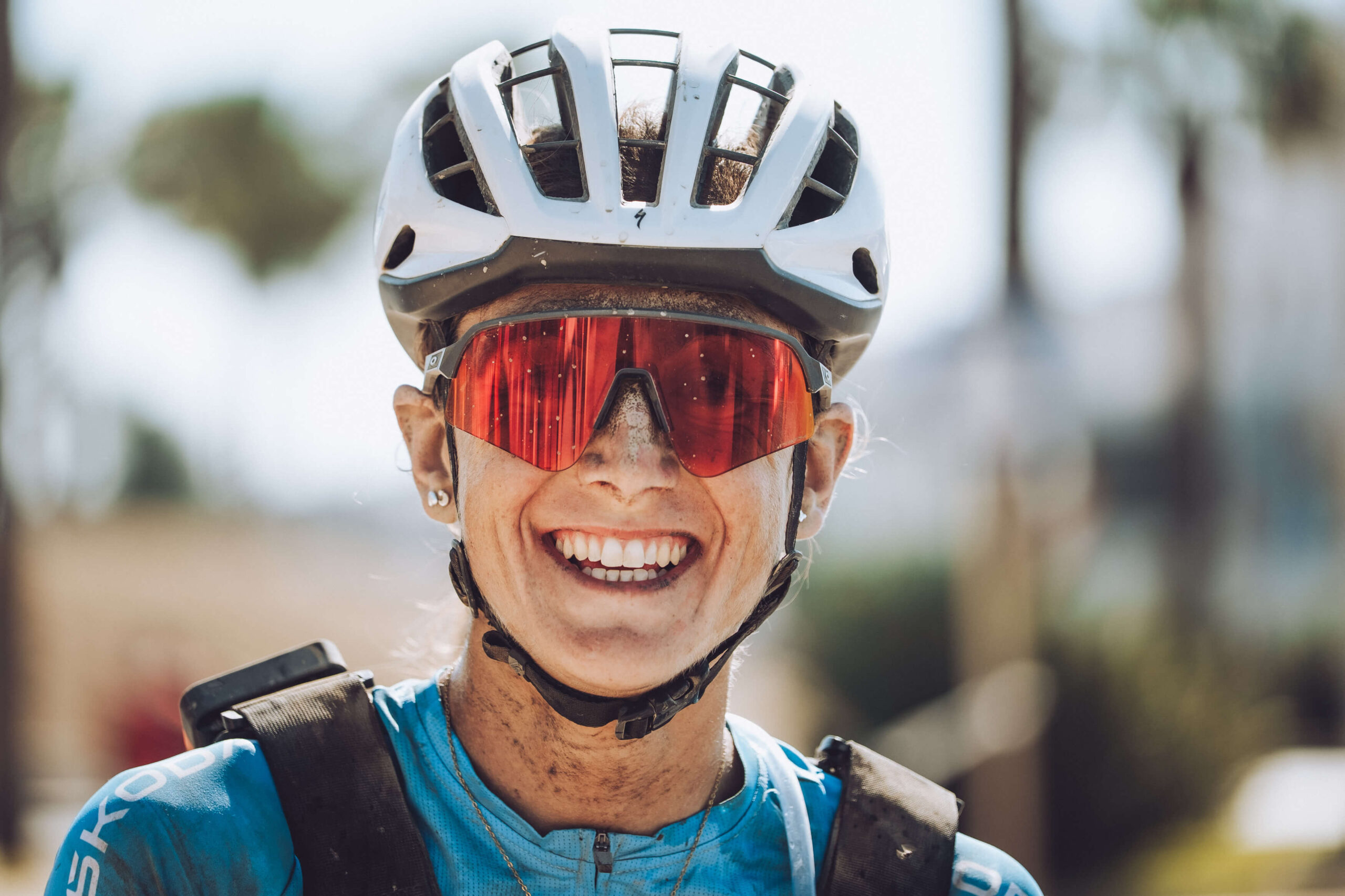
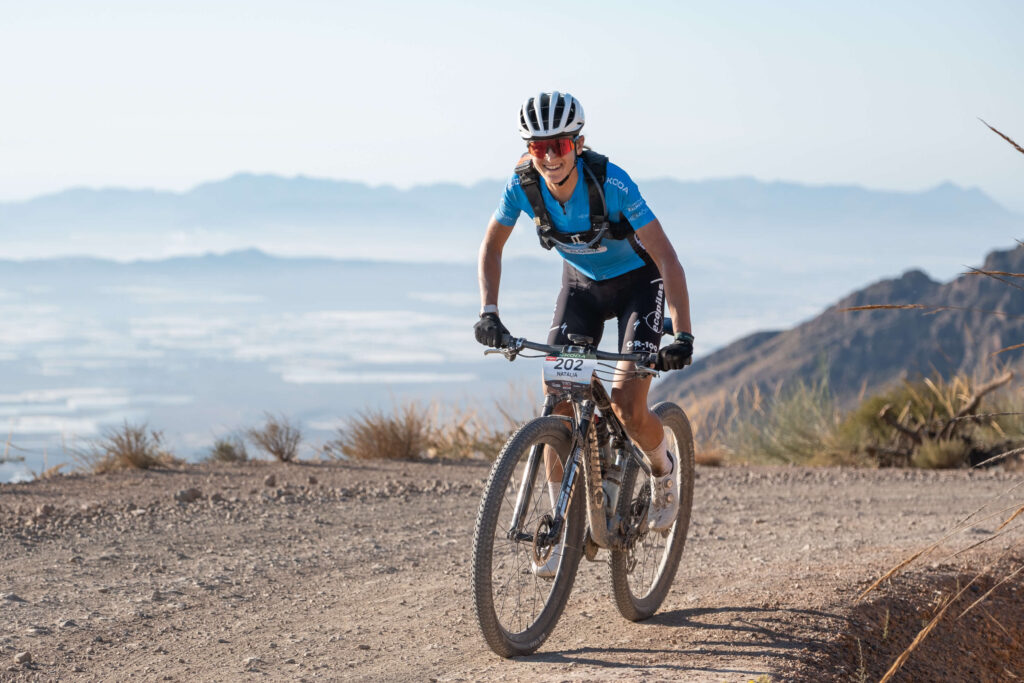
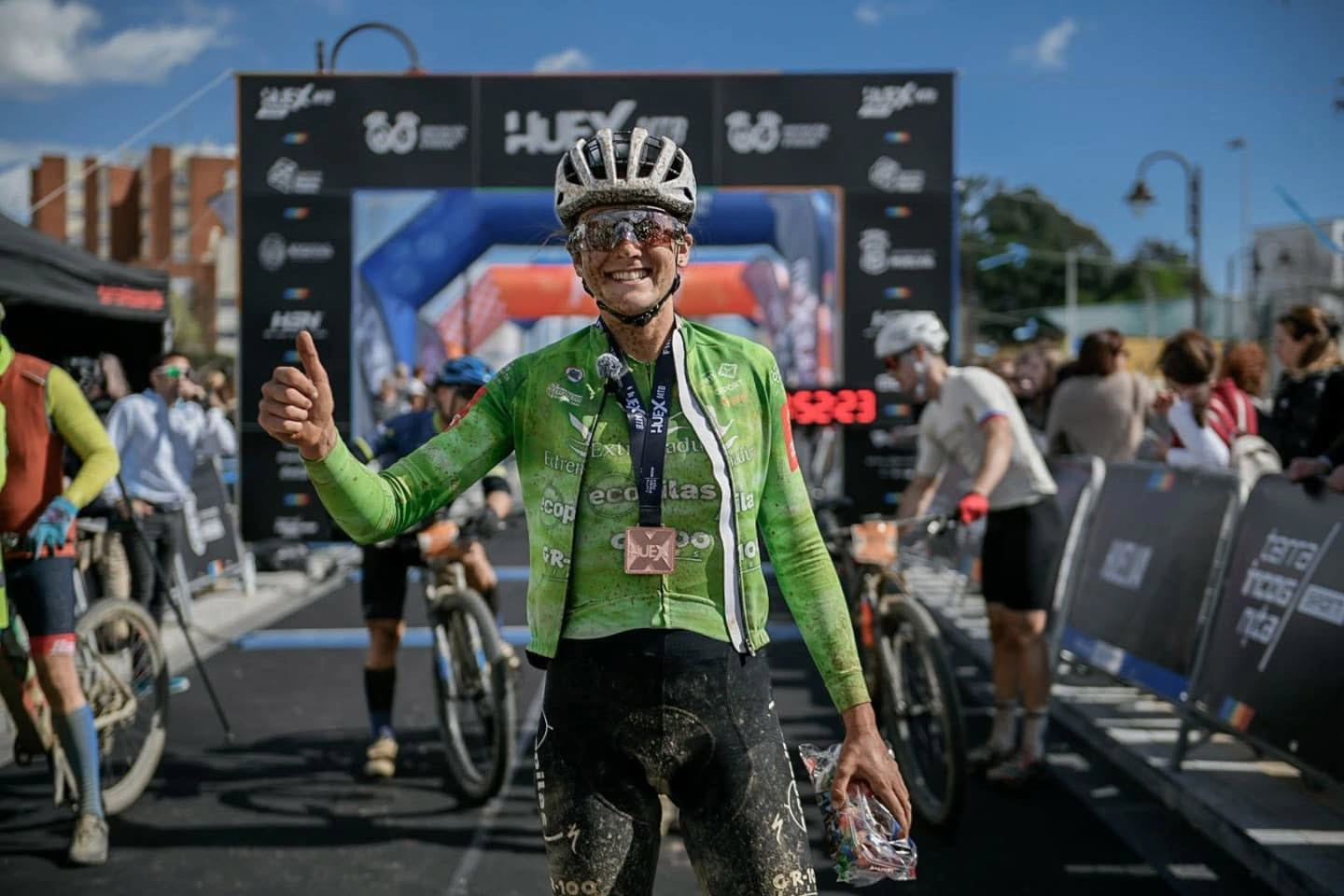
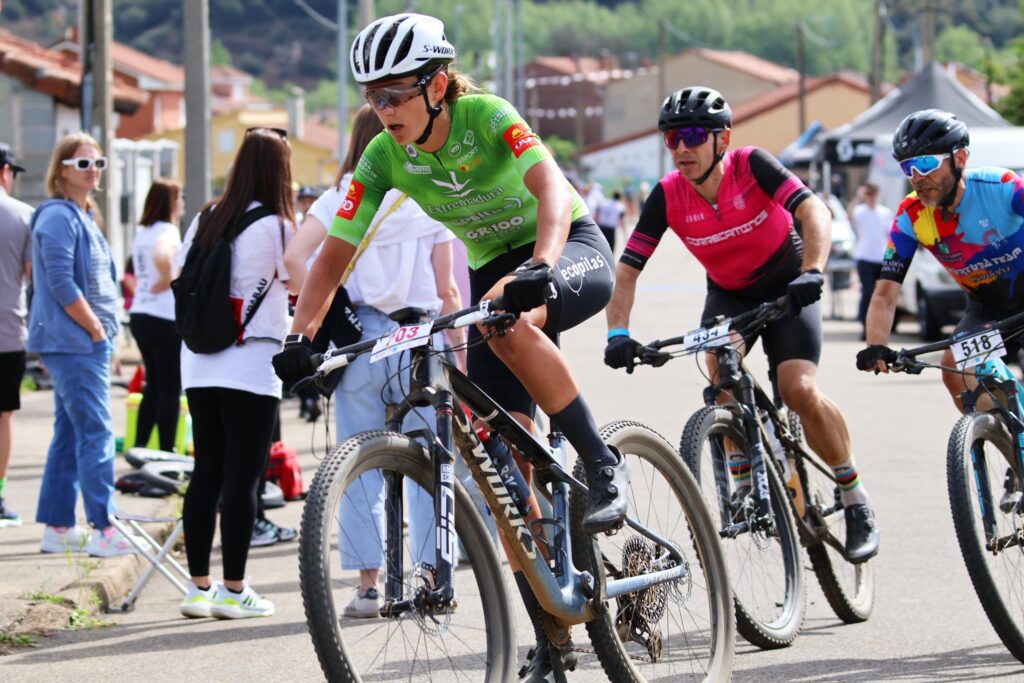
Interview with Natalia Fischer, two-time European XCM champion

– Who is Natalia Fischer? Tell us about your origins and how you discovered your passion for mountain biking.

– I was born in Málaga on December 20, 1993, and I’m 31 years old. I grew up between Marbella and Estepona. I was always a very active child; I was diagnosed with ADHD at a very young age. Being hyperactive, my parents encouraged me to do sports, so I’ve always been disciplined thanks to them. I practiced many different disciplines, but between the ages of eight and eighteen, I played tennis.

I started studying medicine at the University of the Basque Country, where I became interested in athletics, duathlon, and triathlon. A year later, I transferred to the University of Granada, where I combined my medical studies with duathlon and triathlon competitions. I achieved international success, such as becoming European U23 duathlon cross champion and Spanish national champion, among others. However, I had to stop competing due to a hip injury that made running impossible.

That injury led me to try mountain biking, and after only six months of training, I won my first Spanish Mountain Bike Championship in the elite category. Following that victory, several professional MTB teams contacted me, and I had to choose between continuing with medicine or becoming a full-time cyclist. In the end, I chose cycling — and I’m still a professional rider to this day.

– What does it mean to you to have been European XCM Champion twice?

– It’s a huge source of pride. My first European Championship was held in Evolène, a small village in the Swiss canton of Valais, which happens to be where my great-grandfather was from. It felt like racing at home, so that victory was incredibly special. My second title came in the Czech Republic, and it was equally meaningful to wear the European champion’s jersey for two consecutive years — 2021 and 2022. This year, 2025, I won the silver medal at the European Championships held in the Apennines, Italy.

– What has been the toughest race you’ve ever done, and why?

– This year’s World Championship in Verbier, Switzerland. It was 125 kilometers with 5,200 meters of elevation gain through the Swiss Alps — a race that lasted more than seven hours and twenty minutes. I competed with the Spanish national team and finished in fourth place. I did my altitude training at the High-Performance Center in Sierra Nevada. It was the toughest race because of its length and altitude — we were riding at more than 2,500 meters, reaching peaks above 3,000 meters. I remember suffering the most when I had to carry my bike up the Pas de Lona climb after six and a half hours of racing — twenty minutes walking uphill at more than 3,000 meters wearing carbon cycling shoes! I think that day was the hardest I’ve ever endured. 

– How do you manage the pressure of competing at the highest level?

– It took me a long time to learn how to deal with pressure. The elite world is tough — I’ve been through many teams, and in the end, you’re treated like a “product”: if you don’t perform, you don’t get your contract renewed. And sometimes results just don’t come, because racing isn’t a simple equation — many external factors play a role.

Fortunately, this year I’m with one of the best teams, at least for me, where the athlete is valued as a person too. That has given me great peace of mind and helped me have one of my best seasons so far — a five-time Spanish champion, European runner-up, and fourth at the World Championships. As a professional cyclist, I spend more than half the year away from home, racing and training. That lack of personal stability is the hardest part, but I’m learning to handle it better. I’ve always had the support of my parents and now also of my team, Extremadura Ecopilas GR-100 Bikes, with some very special people around me.

– You were very close to the podium at the World Championships in September. What was missing?

– As I mentioned, I finished fourth at Worlds. What was missing? Maybe a bit of race strategy. I was the only Spanish woman in the national team, so I had to defend myself alone without teammates to work with. The winner, the American Kate Courtney — the US riders played their team strategy very well, working together and helping one another, while I had to push against the tide the whole race. Still, I’m very happy with the result.

– What does it feel like to represent Spain in international competitions?

– At the World Championships, you can only compete with your national team, not with your trade team. You have to be selected to participate, otherwise you can’t race. This year I was the only Spanish woman chosen, and that’s a real honor and a privilege.

– What is a typical training day like for you?

– It depends a lot on the time of year. During preseason, from October to December roughly, training is more relaxed. I take the opportunity to have more of a social life, do other sports like gym or hiking, and spend time with my dogs and friends — even enjoying an ice cream here and there.

During the season, training is much more specific — I usually train around three hours a day, focusing on intervals or series, with one full rest day per week. Some days I ride six or seven hours, others just two, but with very demanding intervals.

– How important is mental preparation compared to physical training?

– Both go hand in hand. If your mind isn’t in the right place, you’ll never perform at your best. Mental strength is just as important as physical condition.

– You’ve had serious injuries, like a vertebra fracture while training. How was your recovery?

– Yes, in 2022, during the World Championships in Les Gets (France), I fractured my L1 vertebra. Thankfully, there was no displacement, so I didn’t need surgery — just a brace. Doctors predicted five to six months of recovery, but thanks to the Hyperbaric Center of Estepona, I was fully recovered in just one month after daily one-hour sessions.

Recovery is extremely important to me. Hyperbaric oxygen therapy has real benefits — it helps the body heal faster and improves overall health. I totally recommend it.

– What role do nutrition and rest play in your performance?

– They’re essential. Cycling is a sport where you must perform at 100%, keeping your weight as low as possible without losing strength or compromising your health. I follow a balanced and healthy diet and get blood tests every three months to monitor everything, even though I don’t work with a nutritionist.

Rest is equally important — I sleep at least eight hours per night and take at least one full rest day per week. Recovery is when the body repairs tissues and restores hormonal balance.

I use a very helpful device called WHOOP, which tracks sleep quality, heart rate, and recovery metrics. But in the end, the most important thing is how your body feels.

My life as a professional cyclist basically consists of training in the morning, eating what’s necessary, resting, and recovering to be ready to do it all again the next day.

– How do you see the evolution of women’s cycling in Spain and Europe?

– I think it’s progressing well, especially in road cycling. Mountain biking is improving too, but not at the same pace. In road cycling, a minimum salary has been established for professional contracts, while in MTB that still doesn’t exist. That financial security allows more women to move from amateur to professional levels. More and more brands are supporting women’s cycling, though there’s still a significant pay gap compared to men’s cycling. Overall, I see positive progress — more women in the peloton every day, which makes me really happy.

– Do you think there are still barriers for women in professional cycling?

– Yes and no. Yes, because financially there’s still a huge gap compared to men. But no, because many brands and teams are now betting on women’s cycling, which is helping it grow fast. There are more women riding in groups now than ever before, and that’s a great sign.

– What advice would you give to a young girl who dreams of becoming a professional cyclist?

– I’d tell her to study and get an education, because a sports career is short. And if the opportunity to go pro comes along, never forget to enjoy what you do.

– What values has cycling taught you that you apply to your daily life?

– Cycling has taught me to face life’s toughest moments and to overcome them. Discipline, perseverance, teamwork, empathy, kindness, and the will to fight for what you love — no matter what — are the most beautiful values this sport has given me.

– Do you have any sports idols or people who inspire you?

– I don’t have a particular idol. My parents are my biggest inspiration, and there are also a couple of close people I rely on who bring me peace and calm.

– How would you like to be remembered in the world of cycling?

– As a humble cyclist who gave everything to the sport and helped others along the way.

– What’s your dream goal in your career?

– To win a World Championship.